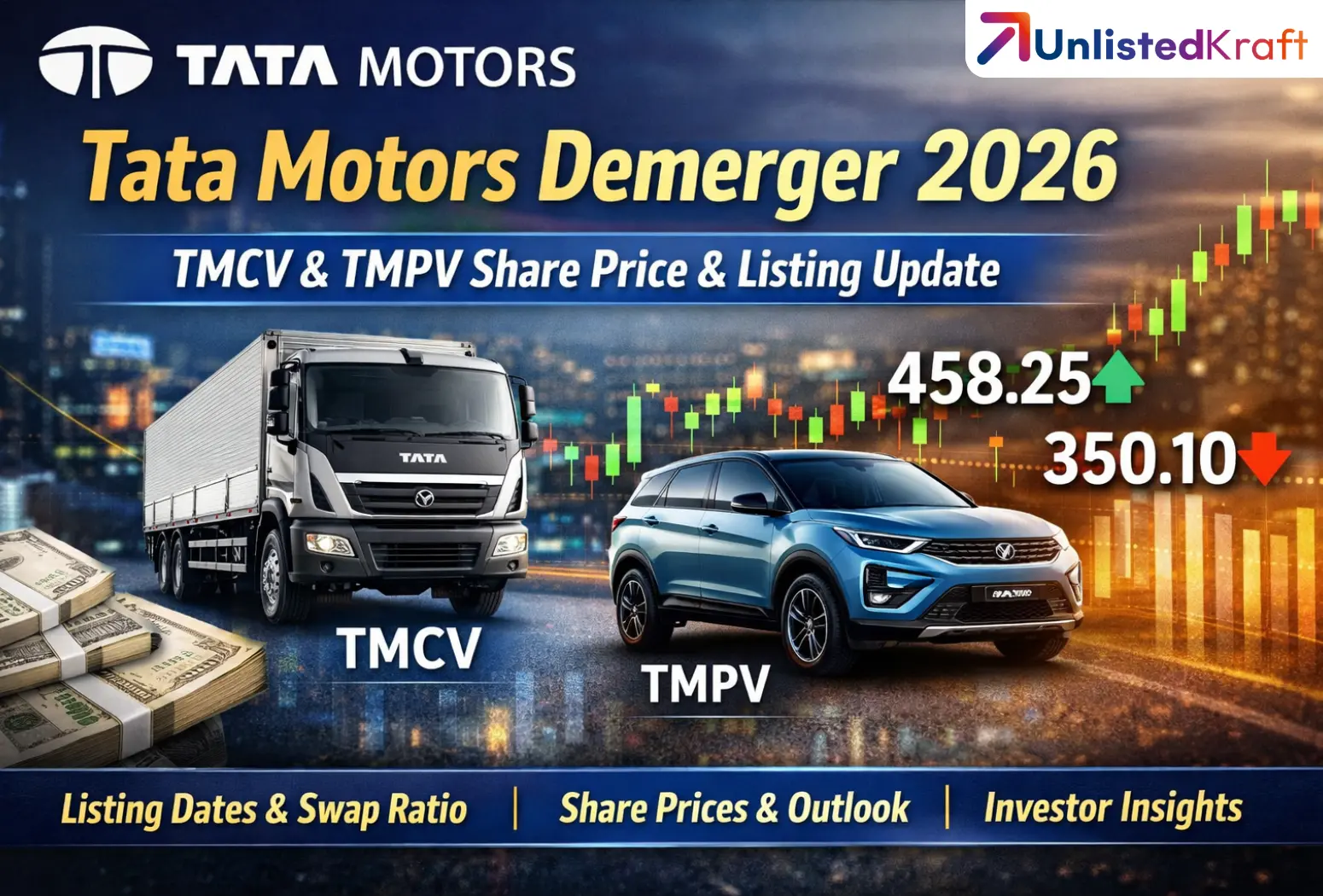
Tata Motors has undergone one of the most significant corporate transformations in the Indian automotive space. The company has split its operations into two separate listed entities:
Passenger vehicles (PV)
Commercial vehicles (CV)
The move is aimed at unlocking value, sharpening business focus and enhancing transparency for investors.
Tata Motors Demerger Details February 2026
The following are the major details of the recent Tata Motors demerger and TMLCV share details:
Particulars
Details
Parent Company
Tata Motors Limited
New Entities Post-Demerger
TMLCV (or TMCV): Tata Motors Commercial Vehicles
TMPV: Tata Motors Passenger Vehicles (including EV business)
Demerger Objective
To unlock value by separating the CV and PV businesses, improve operational focus, and attract segment-specific investors
Tata Motors Share Price (Pre-Demerger)
₹1,000 – ₹1,050 range (subject to market fluctuations)
TMLCV Share Price (Current)
Approximately ₹458-460 as of January 30, 2026 (down ~2-4% post-Q3 results due to exceptional costs)
TMPV Share Price (Current)
Approximately ₹350 as of January 30, 2026
Listing Type
Listing through demerger (not a fresh IPO)
Tata Motors Commercial Vehicles IPO
No separate IPO; shareholders received TMLCV shares in the decided swap ratio
TMLCV Share Allotment Ratio
1:1 (one share of the CV company for each share of Tata Motors held as of the record date)
TMLCV Listing Date
November 2025 (trading debut following demerger effective October 2025)
Tata Motors Commercial Vehicles Listing Date
Same as TMLCV listing date
TMLCV Listing Time
Updated on the BSE/NSE listing circular at debut
Where to Check Live Price
NSE India, BSE India, Moneycontrol, and CNBC Awaaz Live
TMLCV Share Price Today Live
Available on listing day across all major finance platforms; current price ~₹458-460
Tata Commercial Vehicle Share Price
Represents the performance of the standalone commercial vehicle entity; current ~₹458-460
TMPV Share
Represents the passenger vehicle & EV segment of Tata Motors; current ~₹350
Tata Motors CV Share Price Drivers
Domestic & export demand for trucks & buses
EV transition in CV segment
Fleet replacement trends
Infrastructure spending
Market Symbol
TMCV for CV; TMPV for PV
Tata Motors Commercial Vehicle Listing Exchange
NSE & BSE
Tata Motors Commercial Vehicles Stock Type
Standalone CV business entity from Tata Motors
Tata Motors CV Listing
Completed post all regulatory and shareholder approvals in November 2025
TMLCV Share Trading Platforms
NSE, BSE, Moneycontrol, Groww, Zerodha, Upstox, etc.
Tata Motors Commercial Vehicles Share Price Today
Reflects real-time valuation; ~₹458-460 as of January 30, 2026
Separation of Businesses
The commercial vehicle business, including trucks, buses and goods-carriers, has been carved out as a standalone entity (TMLCV/TMCV).
The passenger vehicle business, including cars, SUVs, electric vehicles and the luxury arm (via Jaguar Land Rover), remains in a separate listed company (TMPV).
The demerger became effective on October 1, 2025.
The record date was set as October 14, 2025. Shareholders of Tata Motors as of that date became eligible to receive shares in the newly created commercial-vehicles company.
The newly demerged commercial vehicle company began trading in November 2025.
On listing, the CV company shares traded at a premium to the implied valuation: listing price on NSE was ₹335 per share (28% premium) and on BSE ₹330.25 per share (26% premium).
Allotment / Swap Ratio
The demerger was executed such that existing shareholders of Tata Motors received shares of the new commercial-vehicle company in a ratio of 1:1 (one share of the CV company for each share of Tata Motors held as of the record date).
Key Differences Between TMLCV and TMPV Shares After Tata Motors Demerger
The following table explains all the important differences between these two companies:
TMPV share price reflects PV & EV business performance (~₹350 current)
Tata Motors CV Listing Date
November 2025
Same timeline as TMLCV
Business Drivers
Infrastructure growth, logistics demand, fleet modernisation, EV trucks
Rising EV adoption, SUV demand, and export expansion
Revenue Source
Institutional buyers, transport operators, the public sector, and exports
Retail customers, EV sales, global exports
Profit Margins
Moderate – cyclical business, depends on macro trends
Higher margins – driven by EV and premium SUV sales
Investment Outlook
Stable, long-term industrial growth story
High-growth potential driven by EV revolution
Risk Factors
Interest rates, fuel prices, and industrial slowdown
Competition, EV adoption rate, semiconductor supply
Valuation Approach
Based on asset-heavy CV operations and sales volumes
Based on brand value, EV potential, and consumer demand
Market Symbol
TMCV
TMPV
Where to Track Price Live
NSE, BSE, Moneycontrol, CNBC Awaaz Live
NSE, BSE, Moneycontrol, CNBC Awaaz Live
Ideal for Investors Seeking
Steady performance linked to India’s infrastructure and logistics growth
Long-term capital growth from EV and passenger vehicle expansion
Comparative Outlook: CV Business vs PV Business
Let us understand the outlook between these two companies:
Commercial Vehicle (CV) business: More linked to infrastructure investment, freight/logistics demand, heavy vehicle cycles, exports and capacity utilisation. The margins and cash flows have shown improvement in the recent period. Current market share stands at 35.5%.
Passenger Vehicle (PV) business: Focuses on domestic cars, SUVs, EVs and the luxury segment via JLR. This business faces different competitive pressures, more rapid technology shifts (EVs) and longer lead times for growth.
The separation allows the CV business to benefit from its more stable cash-flow profile while the PV arm focuses on growth and innovation.
Financial & Strategic Highlights of Tata Motors CV Business
Financial Snapshot
In Q3 FY26, the commercial vehicle business reported revenue of ₹21,847 crore (up 16-20% YoY) and EBITDA margins of 12.5-12.6% (up 30-50 bps YoY).
Net profit was ₹705 crore (down 48% YoY due to exceptional costs of ₹1,643 crore, including demerger-related ₹962 crore, labour code ₹603 crore, and acquisition ₹82 crore).
Analysts estimate a standalone value for the CV business reflecting peer multiples, with current P/E around 20-37.
Strategy Behind the Demerger
The commercial vehicle business has distinct capital intensity, demand cycles (linked to freight, infrastructure, logistics) and margin dynamics compared with the passenger vehicle/EV business. Separating the two allows each business to pursue its strategy without cross-subsidisation.
The split is intended to unlock hidden value for shareholders. By making the CV business independent, the market can evaluate it on its own merits rather than as part of a conglomerated entity.
Ongoing developments include the IVECO acquisition on track for closure in Q1 FY27, enhancing the global footprint.
Impact of the Demerger on Shareholders
The following are some of the important insights for shareholders:
Investors who held Tata Motors before the record date now own shares in two separate listed entities - the CV company (TMCV) and the PV-EV/luxury business company (TMPV).
Because each business now has its own listed identity, comparisons (valuations, margins, growth prospects) become clearer.
The market has reacted with early enthusiasm, though recent share price dips reflect Q3 exceptional costs.
For tax and cost-allocation purposes, shareholders are advised to note the announced cost-splitting ratio: 31.15% of the acquisition cost is allocated to the CV company, 68.85% to the PV company.
Why the Tata Motors Listing is Significant
The demerger and listing were significant for the following reasons:
By listing the CV business, Tata Motors has enabled a clearer “pure-play” investment opportunity for the commercial vehicle segment.
The initial listing premium (~26-28%) suggests that the market views the standalone CV business positively - both for its growth potential and value-unlock opportunity.
The move helps remove what is known in corporate finance as the “conglomerate discount” - when a diversified company is valued less than the sum of its parts because of opacity or cross-subsidies.
It also aligns with broader structural trends in India: rising infrastructure spend, logistics growth, demand for commercial vehicles in last-mile connectivity, mining and construction, and exports. The CV market is expected to surpass its pre-pandemic FY19 peak in FY26.
Challenges And What To Watch
The following are some of the important challenges and key points to consider:
The commercial vehicle business remains cyclical: demand tends to fluctuate with economic growth, commodity cycles, infrastructure spend and fuel/interest cost dynamics.
Integration of any overseas acquisitions (for example, the IVECO deal) will need operational discipline and time to translate into profits.
Margins can be impacted by input costs, regulatory changes (emission norms, electric commercial vehicles transition), and capacity utilisation.
For the PV business, which is now in a separate company, risks include stronger competition, technology shifts, margin pressure and high capex for EVs.
Recent Q3 results show profit pressure from one-time costs, leading to share price declines.
Conclusion
Tata Motors (TMCV) shares have been sliding lately. As of early February 2026, it is trading around ₹441–₹458, pretty close to the lowest levels seen in the last 52 weeks. The whole market and auto sector have been under pressure, which isn't helping.
Even though the Commercial Vehicle business is doing well — volumes grew 20% compared to last year, and Tata still holds about 35.5% of the domestic CV market — investor mood is still cautious.
Quick highlights from February 2026:
The stock has dropped quite a bit recently, with some sessions trading between ₹358 and ₹365 before bouncing a little.
Tata Motors still has the biggest range of electric vehicles for personal cars in India.
Commercial vehicles had a strong Q3 FY26 with that 20% growth.
Analysts are mixed: Nomura is still positive on the CV side and has a 'Buy' rating with a target of ₹547, but others are saying 'Hold' for now.
Frequently Asked Questions
What is the current TMLCV share price today?
The TMLCV (TMCV) share price today refers to the live market price of Tata Motors’ Commercial Vehicle division post-demerger. As of January 30, 2026, it is approximately ₹458-460. Investors can check the latest TMLCV share price live on NSE or BSE official websites or financial portals like Moneycontrol or NSE India.
How is TMLCV share price different from Tata Motors share price?
Post-demerger, Tata Motors now primarily represents the CV business (TMCV), trading at ~₹458-460. TMPV represents the PV business, trading at ~₹350. The original Tata Motors share price pre-demerger reflected the combined entity.
When did the TMLCV shares list on the stock exchange?
The Tata Motors Commercial Vehicles (TMLCV/TMCV) listed in November 2025 following SEBI and exchange approvals. Investors can check announcements on BSE/NSE or through Tata Motors’ investor relations page for official updates.
Will existing Tata Motors shareholders get TMLCV shares?
Yes. Shareholders holding Tata Motors shares before the record date (October 14, 2025) received TMLCV shares in a 1:1 ratio (as announced by the company). The same applies to TMPV shares under the demerger plan.
What factors affect the TMLCV share price?
The TMLCV share price depends on:
Demand for commercial vehicles in India and abroad
Profitability and margins of the CV business
Market sentiment around EV adoption for trucks and buses
Economic growth and infrastructure spending
Recent exceptional costs from demerger and labour codes.
How can I check TMLCV share price live?
You can track the TMLCV share price today live on platforms like Moneycontrol, NSE India, BSE India, or CNBC Awaaz Live for real-time updates and expert analysis.
What is the difference between TMLCV and TMPV shares?
TMLCV: Tata Motors Limited – Commercial Vehicles business, focused on trucks and buses.
TMPV: Tata Motors Passenger Vehicles, which includes cars and EVs like Nexon and Tiago EV. Their share prices (TMLCV ~₹458-460 and TMPV ~₹350) reflect their independent performance post-demerger.
Will Tata Motors Commercial Vehicles IPO be separate?
No, there’s no new IPO for the Tata Motors Commercial Vehicle division. It’s a listing through demerger, meaning existing shareholders automatically received TMLCV shares instead of applying for a new IPO.
What will happen to Tata Motors’ original share price after the demerger?
Post-demerger, Tata Motors’ share price adjusted downward to reflect the value transferred to TMLCV and TMPV. However, the combined market capitalization of the entities is expected to remain similar initially. Recent dips are due to Q3 exceptional costs.
Is TMLCV a good long-term investment?
The TMLCV stock could benefit from India’s growing infrastructure push, commercial vehicle demand, and Tata’s EV transition plans. However, investors should review financial performance, P/E ratio (around 20-37), and market conditions before investing.
Are Tata Motors commercial vehicles listed?
Yes, the commercial vehicles business is listed as TMCV on NSE and BSE since November 2025.
What is the market share of Tata Motors in commercial vehicles?
As of Q3 FY26, Tata Motors holds a 35.5% market share in commercial vehicles, up 100 bps sequentially.
Is TASL listed on the stock market?
No, Tata Advanced Systems Limited (TASL) is an unlisted public company and a subsidiary of Tata Sons.
Why is Tata Motors down?
Tata Motors (CV) shares are down ~2-4% as of January 30, 2026, due to a 48% YoY drop in Q3 FY26 net profit to ₹705 crore, primarily from exceptional one-time costs of ₹1,643 crore related to demerger, new labour codes, and acquisitions.
What is TMPV full form?
TMPV stands for Tata Motors Passenger Vehicles, encompassing the PV and EV segments post-demerger.
What is the latest on Tata Motors merger and demerger?
The demerger is complete, with no new mergers announced. Recent focus is on Q3 results and the IVECO acquisition progressing toward Q1 FY27 closure. Discussions emphasize earnings impacts and positive CV demand outlook.
Author: Diwakar Singh
Diwakar Kumar Singh is a BFSI specialist and finance writer with over 7 years of hands-on experience in financial research, content creation, and analysis.
A Gold Medalist in MBA (Marketing) from IMT, he combines deep analytical skills with practical insights gained from evaluating companies, IPOs, unlisted shares, financial ratios, and investment opportunities. Diwakar has personally analysed hundreds of financial instruments and market scenarios, which he uses to break down complex topics into clear, actionable advice.
He has authored numerous in-depth finance articles, published multiple books internationally, and contributed to research publications. His work focuses on helping everyday investors and readers make better-informed financial decisions through well-researched, evidence-based explanations that are always grounded in real-world application rather than theory alone.
 amit@unlistedkraft.in
 +91-8796470040
 +91-8796470040
















 +91-9599071664
 amit@unlistedkraft.in